Bonus points to anyone who’s a fan of The Big Bang Theory and gets the reference in the title of this post! I appreciate you — and I’m also sorry to disappoint, because this post isn’t about that show, it just provided me with a spunky hook for my thoughts this week.
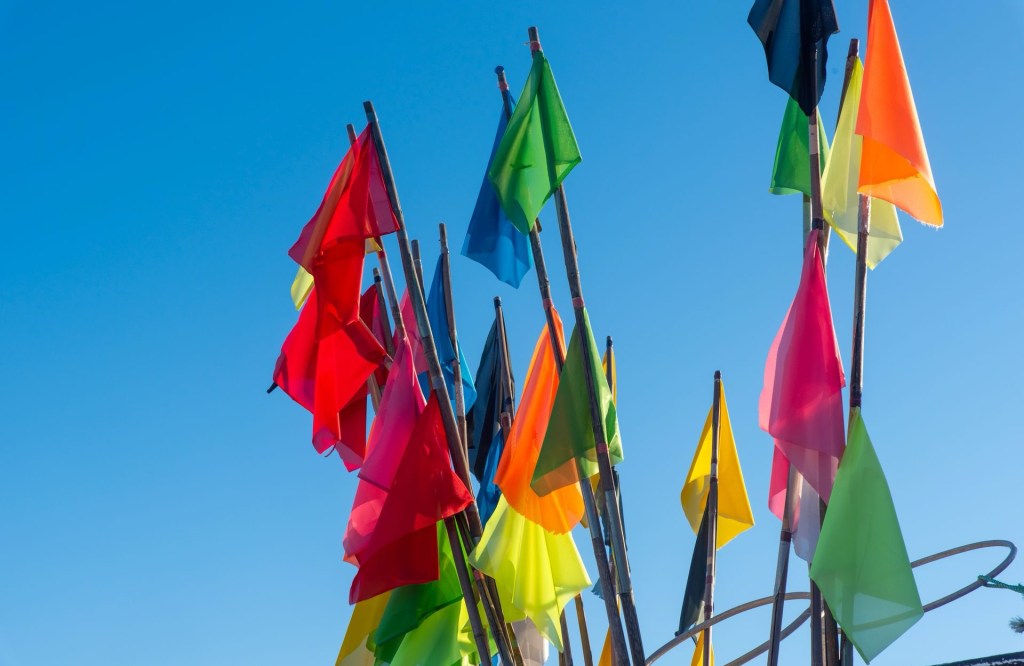
It’s trendy these days to refer to certain behaviors and personality traits people may demonstrate as “green flags” if they’re good things, or “red flags” if they’re bad things. This is unusually straightforward as far as societal aphorisms can get. Green means go; red means stop. We have fun learning that when we’re toddlers. So, a green flag is an indication that this person is good to be around, while a red flag indicates we should stay away from that person. What nice clean-cut and defined categories we can place people in this way!
Except that no person or place or situation is ever that freaking simple, for crying out loud. We’re out here trying to delineate green and red flags like there aren’t also yellow and orange ones to content with, and what exactly are the yellow and orange flags supposed to mean? What do we do then?
If we’re still going with traffic color theory, yellow and orange flags should mean “proceed with caution” I suppose. But it speaks to the real snag in the flag symbolism plan. No one is all green, or all red. In truth, we all carry within us red and orange and yellow and green flags, in various quantities. If this were splotches of paint rather than flags, we’d all be mucky you-know-what brown, and I have to say, that isn’t nearly as fun or attractive, but it is more true to form.
Do I mean that everybody is actually shitty? No. Sure, some people are. But I am working on understanding just how much our choices impact and determine what our life experiences are like, and so maybe the shitty people are the ones who lean too much into their red flag traits. Maybe they’re people who’ve let their red flags become their entire personality, instead of choosing differently. Conversely, maybe the more decent of us in the world are those of us who try to understand our flaws but don’t let ourselves become defined by them.
People are going to have red flags; it’s up to us how we respond to them. If you know that a red flag is a sign to stop, then you stop, or risk becoming a cautionary tale. It’s also not our job to try to change other people’s flags. People have to want that for themselves.
I guess I actually can use The Big Bang Theory to underscore my point here; take Sheldon Cooper as a prime example of someone who, at surface level, is rife with red flags. He is stubborn and demanding, tone-deaf to social norms, and very resistant to change. His friends could easily decide to not be his friends with the way he treats people, but, rather than try to force him to change, they manage only how they respond to him. Sometimes they try to teach and guide him; sometimes they try to trick him; sometimes they look for easy ways out so as to avoid conflict. Now, it’s a sitcom, so obviously tension and drama and hilarity ensue. But if you watch the series from beginning to end, you can see how over time, Sheldon observes and learns from how his friends respond to his red flags, and gradually, subtly works to change his flag colors. He comes to realize that he wants that for himself because he cares about the people in his life and doesn’t want to lose them by continuing to act in these red flag ways.
People are imperfect by nature and change is difficult, especially for creatures of habit like we humans tend to be. In my experience, though, it’s worth it to consider what your red flags might be, and try to balance making space to understand them with not allowing them to rule the roost. It’s also important to lean into your green flags when you can. Find the good and go with it. And, don’t be surprised to discover your yellow and orange flags. So much of ourselves falls in that in-between space, and it takes time and effort to tease it all out and make sense of it.
At the end of the day, it is not the colors of our flags that determine who we are, but the choices that we make about them. I’m not sure if I’d call that fun with flags, but, it’s an interesting process to be sure.

